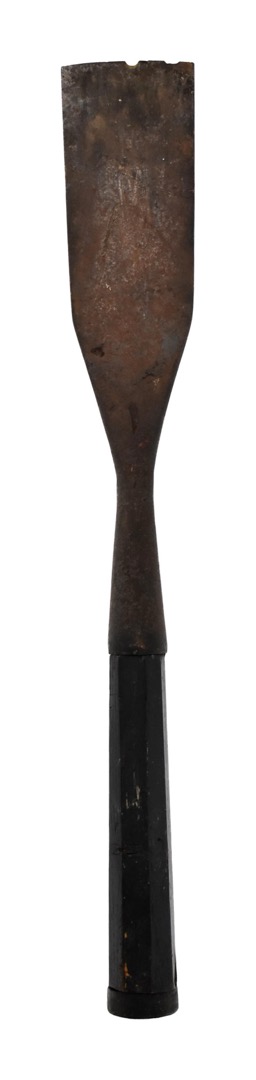
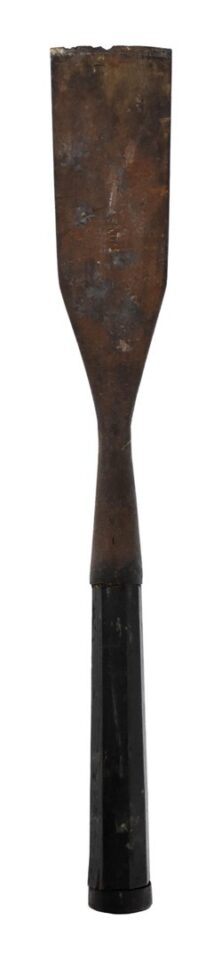
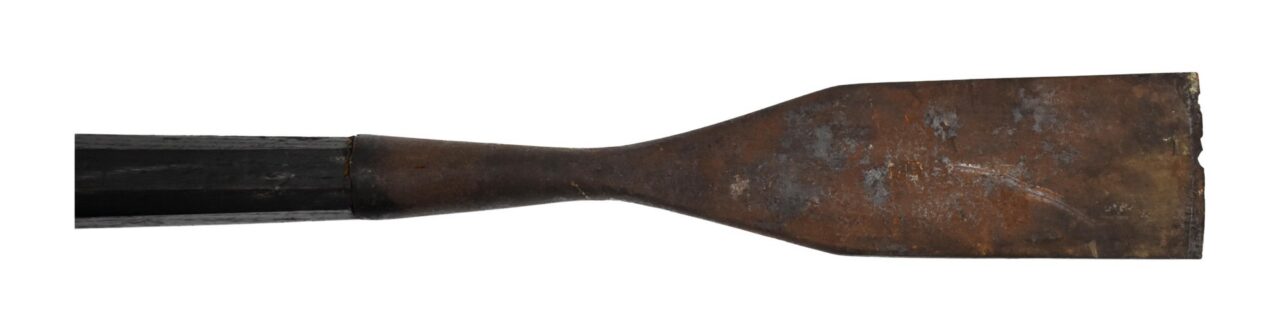
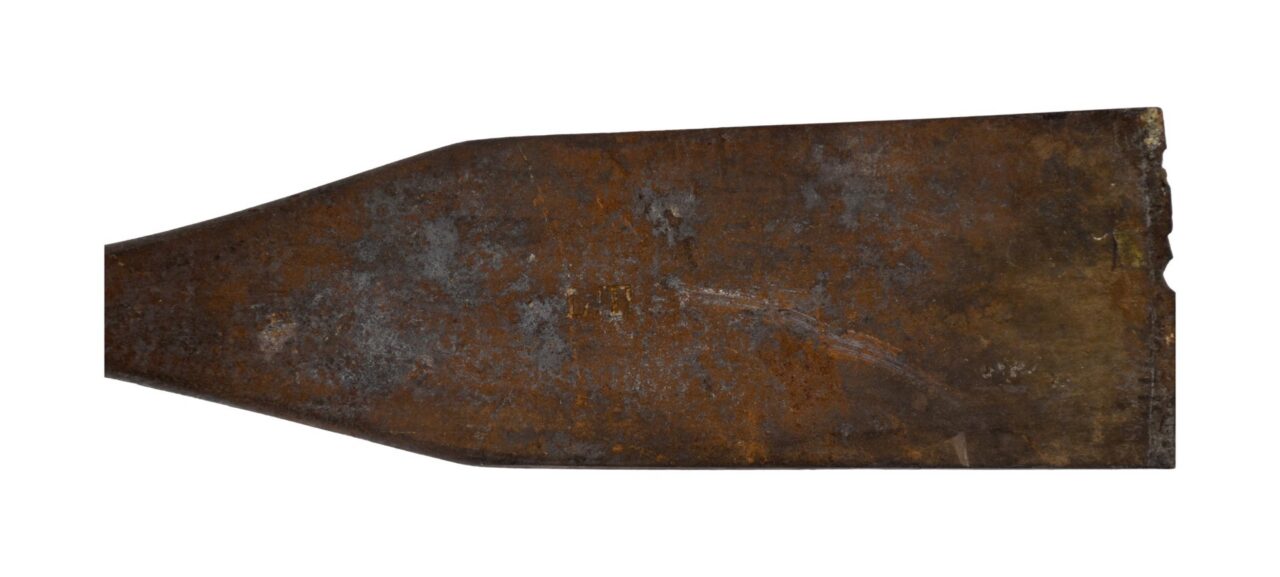
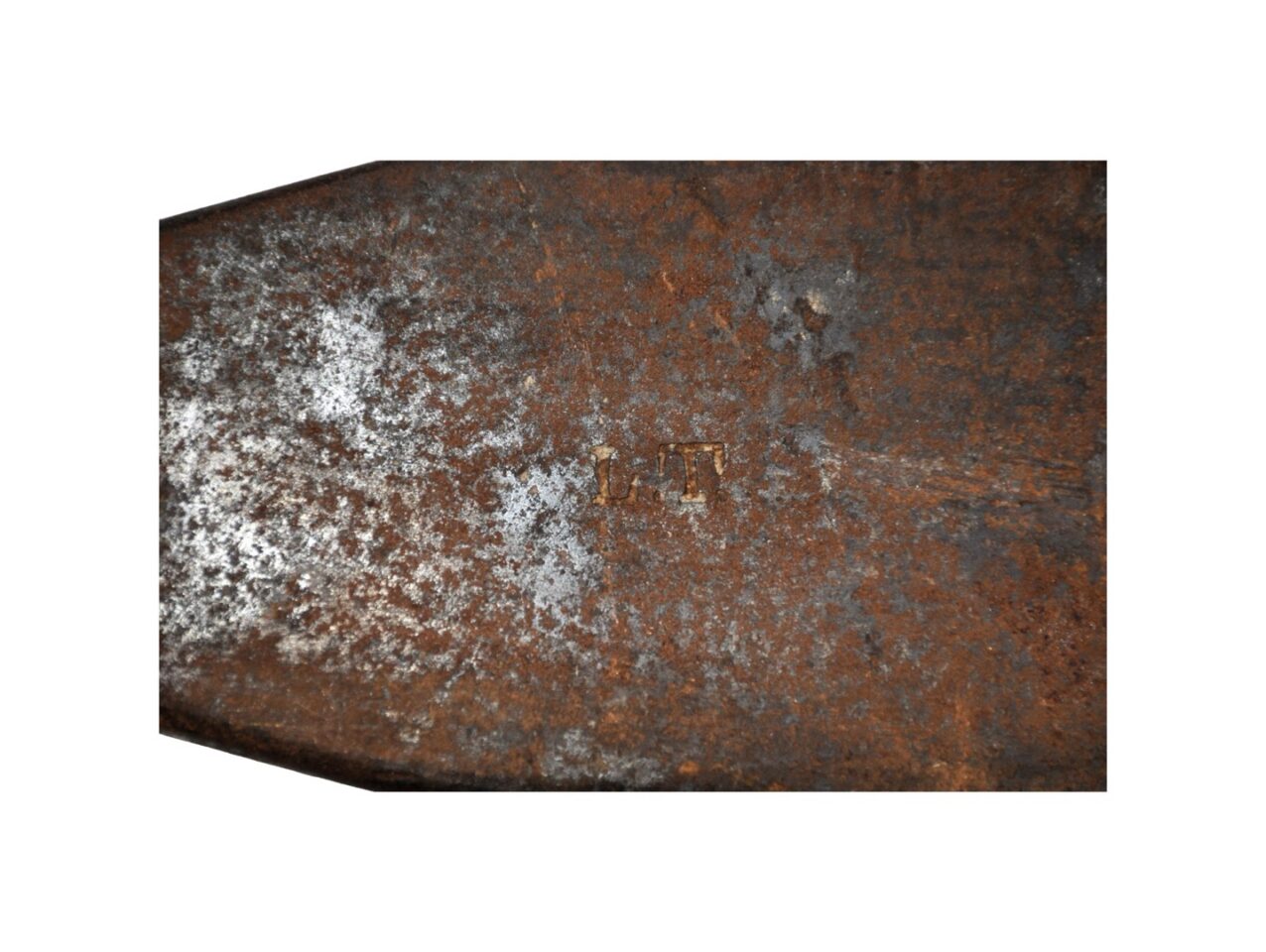
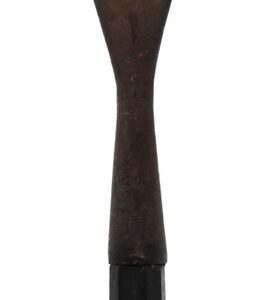
(American, 1800–1854). An important mid-19th C. piece of New Bedford’s maritime past and a potentially significant addition to the known work of Lewis Temple, one of the most important figures in the history of the American whale fishery. The tool is a laminated iron and steel, wide-socket carpenter’s slick, or large paring chisel, with a 3-inch-wide blade having a slight rearward taper. Slicks were used to pare, shave, and flatten the faces of mortises and tenons, scarf joints, and other large-scale joinery. Unlike chisels intended to be struck with a mallet, the slick was pushed and guided by hand and was commonly maintained with a razor-sharp cutting edge. It retains what appears to be its original handle, fashioned from a ring-porous hardwood, probably red oak, and fitted with its original steel handle ring. The handle has become thoroughly blackened, a characteristic frequently encountered on tools habitually used in the whaling industry, where repeated contact with sperm oil and whale oil darkened the wood over time. As a tool type, the carpenter’s slick is neither particularly rare nor inherently important. Such tools were a requisite part of the working chest of a house carpenter, timber framer, or shipwright well into the 20th century. This example, however, is distinguished by the stamped initials “LT,” its securely mid-19th-century construction, its blackened handle, and its provenance from a New Bedford, Massachusetts, collection. Taken together, these characteristics strongly suggest that it was made by the celebrated Black New Bedford blacksmith Lewis Temple. Temple was a documented manufacturer of specialized whaling implements, including harpoons and cutting spades, and likely also produced lances and perhaps boarding knives, blubber pikes, and related maritime tools. From 1836 until his death in 1854, he maintained a blacksmith shop on the wharf at the foot of Walnut Street in New Bedford. He is best known for developing, in the late 1840s, the first truly successful toggle harpoon used in the American whale fishery, a revolutionary innovation that greatly improved the effectiveness of the whaleman’s most essential implement. Although Temple is not presently known to have manufactured conventional woodworking or shipwright’s tools, this slick presents the strong possibility that he did so. If the attribution is correct, it offers important additional evidence concerning Temple’s work, the range of objects produced in his shop, and the broader commercial activities of one of New Bedford’s most historically significant craftsmen. Other dedicated edge-tool manufacturers were active in New Bedford during this period, including Braddock D. Hathaway (1806–1879) and Nicholas and J. M. Taber, associated with the Taber Plane Company, collectively active from approximately 1785 to 1872. Demand for tools was considerable, however, both within the growing city and among its shipyards, maritime trades, and vessels. A slick, unlike a broadaxe, adze, plane, or highly specialized cooper’s tool, would not have been especially challenging for a skilled blacksmith to produce. Indeed, its form and laminated construction are closely related, although on a smaller scale, to several varieties of cutting spades used in the whale fishery and known to have been made by Temple. The initials alone cannot establish the maker with absolute certainty, particularly given the presence of other edge-tool manufacturers in New Bedford. Nevertheless, the combination of the “LT” stamp, mid-19th-century date, blackened original handle, maritime associations, and New Bedford provenance makes the attribution to Lewis Temple particularly compelling. This slick may represent a unique and important addition to the known production of a major figure in American maritime history and is, in any event, a substantial and evocative artifact of New Bedford’s whaling and shipbuilding past. Blade width: 3 1/2″ inches. Overall length: 23″. A special thanks to maritime historian Michael P. Dyer for his assistance cataloging this lot. Shows wear and use appropriate for its age. Chipping and minor loss to blade edge.
The Alfred J. Walker Estate and More Part II
August 29th, 10am
Important Carpenter’s Slick by Lewis Temple